Landscape rock at a glance
| Rock | Look | Common sizes | About lb per cu yd | Depth (2× rule) | Best for |
|---|---|---|---|---|---|
| River rock | Rounded, smooth, mixed earth tones | 3/8”–8” | 2,700 | 2–6” by size | Beds, dry creek beds, drainage |
| Mexican beach pebbles | Very smooth, glossy grey to black | 1/2”–5” | 2,800 | 2–3”, or one layer for large | Accents, water features, modern beds |
| Lava rock | Porous, rough, red or black | 3/8”–3” | 1,200 | 2–4.5” | Beds, slopes, light-load areas |
| Crushed granite | Angular chips, pink, grey or tan | 1/4”–1” | 2,700 | 2” | Xeriscapes, beds, informal paths |
| Decomposed granite | Fine, sandy, golden to tan | Fines to 3/8” | 2,600 loose | 2–6” compacted | Paths, patios, between pavers |
| Marble chips | Bright white | 3/8”–1” | 2,700 | 2” | Formal beds, contrast |
| Limestone chips | Buff, grey or white | 3/8”–1” | 2,700 | 2” | Beds, borders |
| Cobblestone | Large rounded stones | 3”–8” | 2,600 | One layer | Edging, creek beds, borders |
| Flagstone | Flat slabs | 1”–3” thick | Solid stone, 145–172 lb per cu ft | n/a | Patios, paths, stepping stones |
| Boulders | Single large stones | 1 ft and up | Solid stone, about 165 lb per cu ft | n/a | Accents, walls, retaining |
The depth rule used across this site is about twice the average stone size, never less than 2 inches, with cobbles laid one stone deep. The rock calculator applies it automatically when you choose a size.
River rock
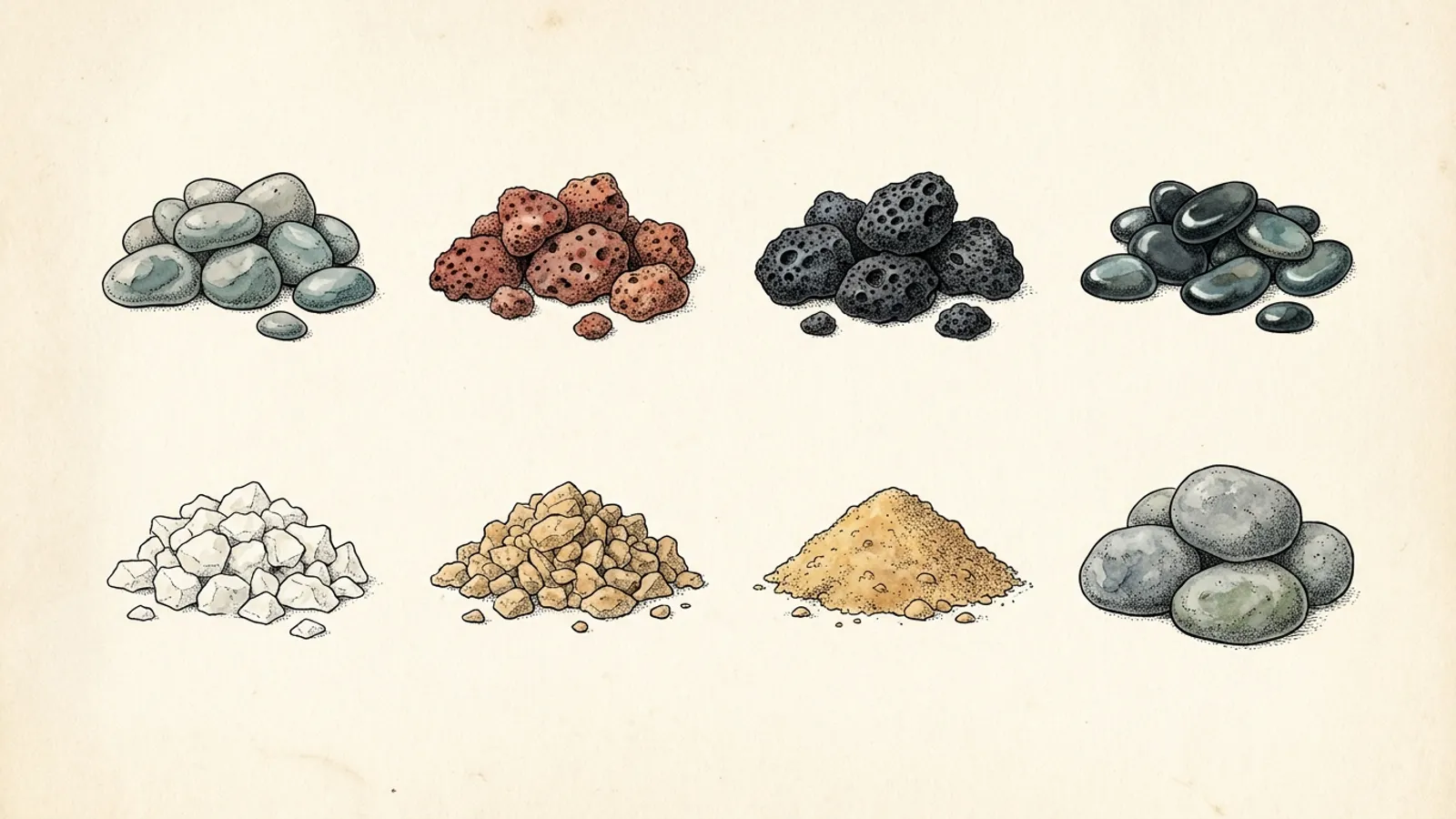
Water-worn stone, rounded and smooth, usually in a mix of greys, tans and rust. It is the default choice for dry creek beds, downspout splash areas and beds where you want a natural look. Round stones roll, so it is not good underfoot and it needs edging. Sold in many size bands, from small pebbles to large cobbles. Calculate it with the river rock calculator.
Mexican beach pebbles
Very smooth, dense pebbles in grey to near-black that look polished when wet. They come from beaches in Mexico and cost more than most landscape rock, so they are often used in smaller accent areas: around water features, in modern planters, as a border between pavers. Large sizes (3–5 inches) are often placed one by one in a single layer. At about 2,800 lb per cubic yard they are slightly heavier than river rock.
Lava rock
Volcanic scoria full of gas bubbles, in red or black. The bubbles make it the lightest landscape rock by far, about 900–1,500 lb per cubic yard. Its rough surface locks together and stays on slopes better than round rock, but it is sharp to handle and catches leaves. Red can fade over time. See the lava rock calculator.
Crushed granite
Granite broken into angular chips, often in pink, grey, gold or tan depending on the quarry. The sharp edges lock together better than round rock, so it is used for informal paths as well as beds, and is a staple of dry-climate landscapes. Not to be confused with decomposed granite, which is much finer.
Decomposed granite
Granite that has weathered into small particles and dust. Wetted and compacted, it forms a firm, natural-looking surface for paths and patios. It needs a compaction allowance when you order and can erode on steep slopes; stabilized versions with a binder resist that. Use the decomposed granite calculator.
Marble and limestone chips
Crushed marble gives bright white beds that stand out against dark plants and mulch; limestone chips are softer buff and grey tones. Both are calcium carbonate, so they can slowly raise soil pH. White rock also reflects a lot of light and heat in full sun.
Cobblestone
Large rounded stones, roughly 3 to 8 inches, used for borders, edging, dry creek beds and areas where you want texture. They are laid one stone deep, packed close, rather than in a thick layer.
Flagstone
Flat slabs of sandstone, limestone, quartzite or slate, used for patios, paths and stepping stones. Sold by the ton or pallet; how far a ton goes depends on the thickness. See the flagstone calculator.
Boulders
Single large stones for focal points, natural-looking retaining walls and edges. Sold by the ton or by the piece, and heavy enough that weight matters for delivery and placement. Estimate each one with the boulder weight calculator, or a whole wall with the stone wall calculator.
Riprap
Large angular rock placed in a thick layer to stop erosion on banks, shorelines and culvert outlets. Not decorative so much as structural; see the riprap calculator.
Choosing by use
| Use | Good choices | Avoid |
|---|---|---|
| Walkway you walk on daily | Decomposed granite, small crushed granite | Large round river rock, beach pebbles |
| Planting beds | 3/4”–1½” landscape rock, crushed granite, lava rock | Very large cobbles that bury small plants |
| Dry creek bed or drainage | 1”–3” and larger river rock, cobbles, edge boulders | Fine material that washes away |
| Slopes | Angular rock, lava rock | Round rock that rolls |
| Roof garden or planter | Lava rock (light) | Heavy rock without checking the load |
| Around acid-loving plants | River rock, granite, lava rock | Marble and limestone chips |
Names vary by region and supplier: one yard's "desert gold" may be crushed granite and another's decomposed granite. Ask for the rock type and its size in inches, and look at the pile if you can.
Questions people ask
- What are the main types of landscape rock?
- The most common are river rock, lava rock, Mexican beach pebbles, crushed granite, decomposed granite, marble and limestone chips, cobblestones, flagstone and boulders. They differ mainly in shape, size, color, weight and whether they pack down or stay loose.
- What is the lightest landscape rock?
- Lava rock. Its gas bubbles make it about 900 to 1,500 pounds per cubic yard, roughly half the weight of river rock, which is useful on roof gardens and in planters.
- What landscape rock is best for walkways?
- Decomposed granite compacts into a firm surface that is comfortable to walk on. Small angular crushed granite also works. Round river rock and beach pebbles roll underfoot and are better for beds and borders.
- What rock is best for drainage areas?
- Washed river rock of 1 to 3 inches or larger is the usual choice for dry creek beds and downspout areas, because it lets water through and is heavy enough to stay put in moderate flows. For real erosion control on banks, use riprap.
- Do marble chips change the soil?
- Marble and limestone are calcium carbonate and can slowly raise soil pH where they sit. Avoid them around acid-loving plants such as azaleas, rhododendrons and blueberries.