How the stone wall calculator works
A stone wall is mostly stone with some gaps, so the calculator works out the wall’s volume, takes the share that is actual stone, and weighs it:
wall volume (cu ft) = length × height × thickness
tons = wall volume × solid % × stone density (lb/cu ft) ÷ 2,000 × (1 + extra %)
The solid % is the key estimate. Flat, cut wall stone fits tightly with small gaps; rounded boulders leave big ones. The calculator starts from these figures, which you can change:
| Wall type | Solid stone, about | What it looks like |
|---|---|---|
| Flat or cut wall stone | 80% | Flat-bedded pieces with tight joints, chinked with small stones |
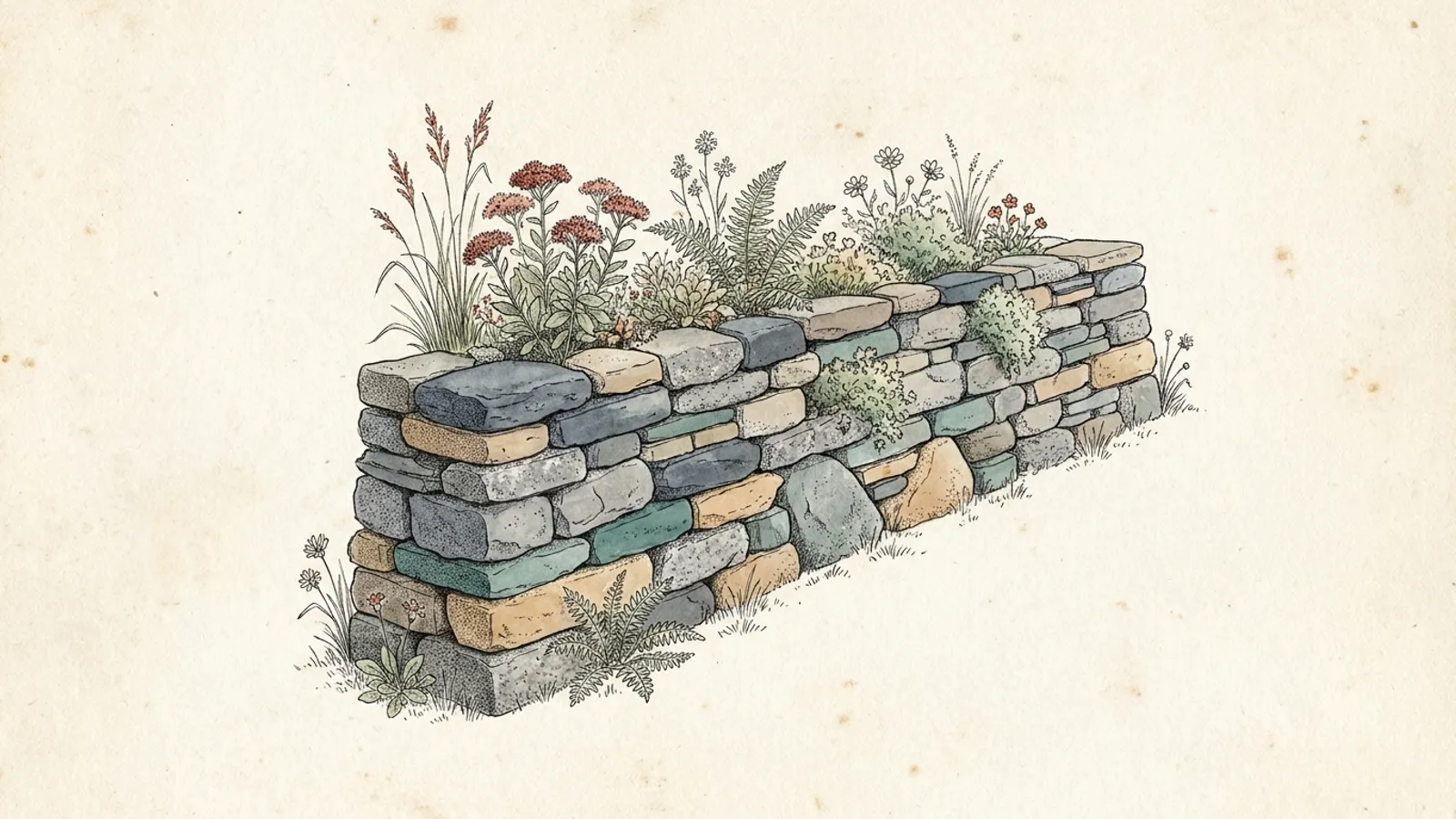
| Dry-stacked fieldstone | 70% | Natural, irregular stones fitted by hand |
| Rounded boulders | 60% | Large boulders stacked or set in one or two courses |
Worked example: a fieldstone garden wall
A dry-stacked fieldstone wall 20 ft long, 2.5 ft high and 1.5 ft thick:
- Wall volume: 20 × 2.5 × 1.5 = 75 cu ft
- Solid stone: 75 × 0.70 = 52.5 cu ft
- Weight: 52.5 × 165 lb = 8,663 lb, plus 10% = 9,529 lb, about 4.8 tons
Worked example: a boulder retaining wall
Rounded granite boulders, wall 30 ft long, 3 ft high and 2.5 ft thick:
- Wall volume: 30 × 3 × 2.5 = 225 cu ft
- Solid stone: 225 × 0.60 = 135 cu ft × 168 lb = 22,680 lb, plus 10% = about 12.5 tons
- With boulders averaging 2.5 ft, one boulder deep: 12 along × 2 courses = about 24 boulders
The boulder count is a rough guide to how many pieces to expect, not a substitute for picking stones at the yard. Check what a single boulder weighs with the boulder weight calculator before you plan how to move them.
Square feet of wall per ton
Yards often quote wall stone by how much wall face a ton builds. Here is that figure from the math above, at about 165 lb per cubic foot:
| Wall thickness | Cut stone (80%) | Fieldstone (70%) | Boulders (60%) |
|---|---|---|---|
| 6 inches | about 30 sq ft | about 35 sq ft | about 40 sq ft |
| 12 inches | about 15 sq ft | about 17 sq ft | about 20 sq ft |
| 18 inches | about 10 sq ft | about 11.5 sq ft | about 13.5 sq ft |
| 24 inches | about 7.5 sq ft | about 8.7 sq ft | about 10 sq ft |
Thin 6 inch walls are usually facing stone against a slope or a veneer, not freestanding walls. A freestanding dry-stone wall needs a broad base to stand up on its own.
Planning the wall
- Thickness. A common rule of thumb for dry-laid walls is a base at least half as thick as the wall is tall. The faces lean slightly inward toward the top (the “batter”), so the top is narrower. Use the average thickness in the calculator.
- Footing. Dig out topsoil and set the first course on firm ground or a compacted gravel base. The first course is usually the biggest stones and is partly buried.
- Drainage. Retaining walls need free-draining gravel behind them so water does not build up and push the wall over. That gravel is a separate order.
- Height limits. Many places require a permit or an engineered design for retaining walls above a certain height, and any wall holding back a driveway, building or steep slope deserves a professional look. Check local rules before you build.
- Culls. Some stones won’t fit anywhere. The 10% extra covers them; with irregular fieldstone, some builders allow more.
Estimating stone wall cost
The calculator multiplies tons by your price per ton for the stone. For a full budget, add:
- Stone: tons × the yard’s price per ton (or per piece for large boulders; divide the piece price by the estimated tons to compare).
- Delivery: often a flat fee per load, set by distance and truck size. Heavy boulder walls may need several loads or a truck with a crane.
- Base and drainage gravel, and fabric for retaining walls.
- Equipment: a skid steer or mini excavator for boulders, or hand tools and a lot of time for fieldstone.
- Labor: for a professionally built wall, usually the largest cost. Get it quoted per face square foot or per linear foot, and make sure quotes cover the same wall height and thickness.
- Permits or engineering, where required.
The landscape rock cost guide explains how to compare per-ton and per-yard prices.
This is a material estimate. The share of solid stone depends on the stone and the builder, and real stone varies in density. Ask your stone yard what a ton of their wall stone typically builds, and compare it with the calculator.
Questions people ask
- How do I calculate how much stone I need for a wall?
- Multiply length × height × thickness in feet to get the wall's volume in cubic feet. Multiply by the share that is solid stone (about 70 percent for dry-stacked fieldstone) and by the stone's density (about 165 pounds per cubic foot), then divide by 2,000 for tons.
- How many square feet of wall does a ton of stone build?
- It depends on the thickness. For dry-stacked fieldstone, a ton builds about 35 square feet of wall face at 6 inches thick, 17 square feet at 12 inches and 11.5 square feet at 18 inches.
- How many tons of boulders do I need for a boulder wall?
- A boulder wall 30 feet long, 3 feet high and 2.5 feet thick takes roughly 12 to 13 tons of granite boulders, assuming the boulders fill about 60 percent of the wall and 10 percent extra for stones that don't fit.
- How much does a stone wall cost?
- There is no reliable national figure, because stone, delivery and labor vary so much by region. Add up the stone (tons × your yard's price per ton), delivery, base and drainage gravel, any permit or engineering, and labor, which is often the largest part.
- How thick should a dry stone wall be?
- A common rule of thumb for dry-laid walls is a base at least half as thick as the wall is tall, narrowing slightly toward the top. Retaining walls also need to lean back into the slope. Taller retaining walls may need an engineered design and a permit.