How the riprap calculator works
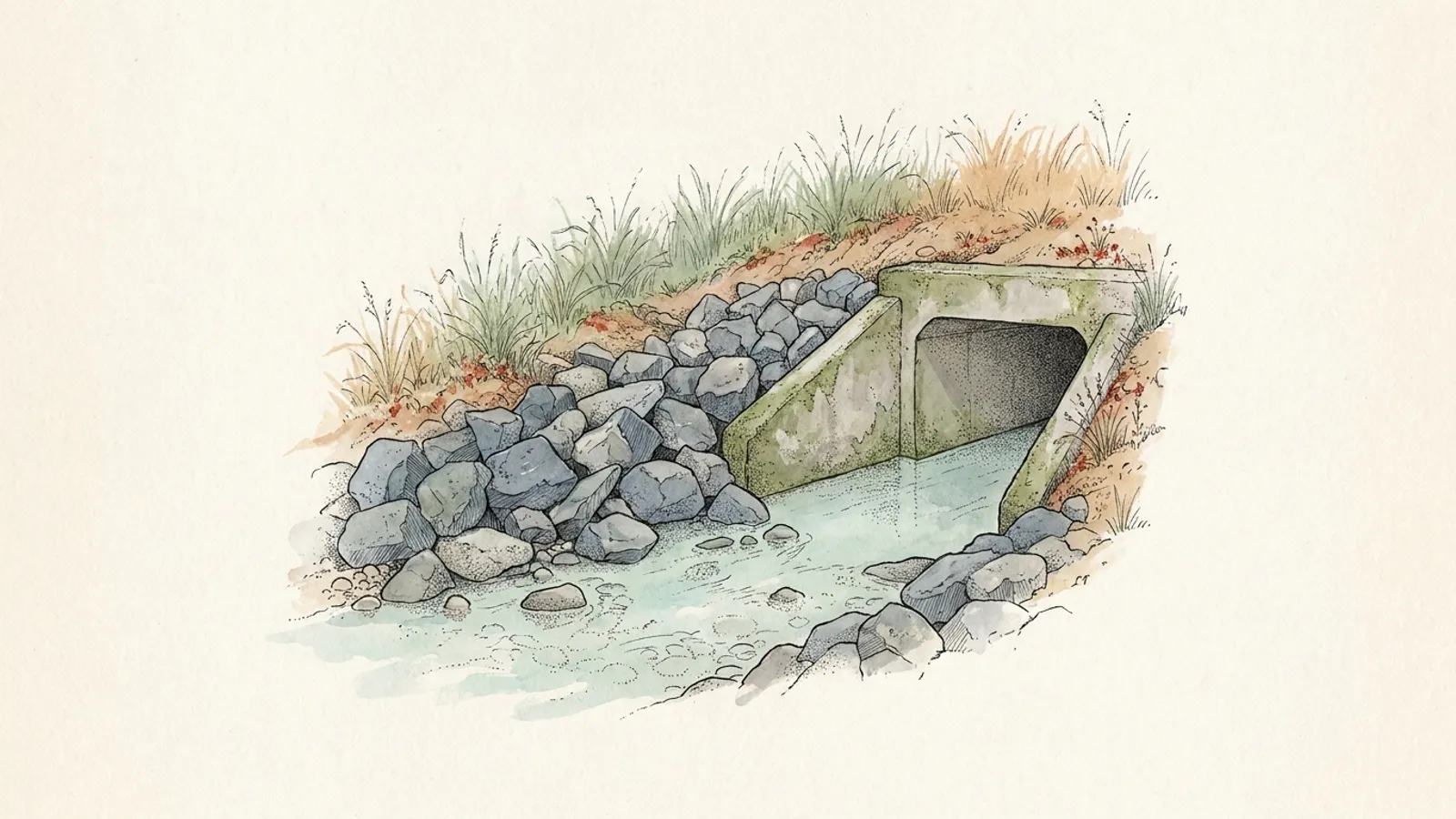
Riprap is large, angular rock placed to stop erosion on banks, ditches, shorelines and culvert outlets. The quantity math is simple; the important part is the layer thickness, which depends on the stone size.
area (sq ft) = length of bank × width along the slope face
cubic yards = area × thickness (in) ÷ 12 ÷ 27
tons = cubic yards × about 1.5
Worked example
A bank 50 ft long, 10 ft measured down the slope face, with riprap of 6 inch median size (largest stones about 12 inches):
- Area: 50 × 10 = 500 sq ft
- Thickness: 12 inches = 1 ft, so volume = 500 cu ft, plus 10% = 550 cu ft
- Cubic yards: 550 ÷ 27 = 20.4 cu yd
- Tons: 20.4 × 1.5 = 30.6 tons
Measure along the slope, not across the map
The width that matters is the length of the slope face the rock will sit on. If you only know the height of the bank and its steepness, use this table (H:V means horizontal run to vertical rise):
| Slope (H:V) | Face length per foot of rise | Bank 4 ft high |
|---|---|---|
| 1.5:1 | 1.80 ft | 7.2 ft |
| 2:1 | 2.24 ft | 8.9 ft |
| 3:1 | 3.16 ft | 12.6 ft |
The face length is √(run² + rise²). Add the toe: riprap is usually carried down into a trench or apron at the bottom of the slope so the water cannot undercut it. Include that area too.
Layer thickness: the stone-size rule
Riprap is described by its gradation: D50 is the median stone size (half the stones by weight are smaller) and D100 is the largest. A widely used rule, found in U.S. Army Corps of Engineers and Federal Highway Administration guidance, is that the layer should be at least D100 thick and at least 1.5 × D50 thick, whichever is greater. With a typical gradation where the largest stones are about twice the median, that works out to about 2 × D50: the same “twice the stone size” idea used for landscape rock on the rest of this site.
| Median stone (D50) | Largest (D100) | Layer thickness | Tons per 100 sq ft |
|---|---|---|---|
| 6” | about 12” | 12” | about 5.6 |
| 9” | about 18” | 18” | about 8.3 |
| 12” | about 24” | 24” | about 11.1 |
| 18” | about 36” | 36” | about 16.7 |
Riprap is sold in classes or grades whose names and sizes vary by state transportation department and by quarry. Ask the supplier for the actual D50 and maximum stone size of the class they offer, then pick the closest row or type your own thickness.
Riprap stone sizes and weights
Classes are often specified by stone weight rather than size. A rough conversion for a stone of about 165 lb per cubic foot, treated as a ball:
| Stone size | About weight of one stone |
|---|---|
| 6” | 11 lb |
| 9” | 36 lb |
| 12” | 86 lb |
| 18” | 290 lb |
| 24” | 690 lb |
| 36” | 2,330 lb |
For individual large stones, the boulder weight calculator gives a better estimate from three measurements.
Weight per cubic yard
Placed riprap weighs roughly 1.4–1.7 tons per cubic yard (2,800–3,400 lb). It is heavier than a loose pile of landscape rock because the angular stones are placed and keyed together, with smaller stones filling gaps. The calculator uses 1.5 tons. Many quarries sell riprap by the ton, so the ton figure is what you will usually order.
Before you place riprap
- Check whether you need a permit. Work in or next to streams, rivers, lakes and wetlands is regulated in many places. Talk to your local authority before you start.
- Get a design for anything that carries real flow. Stone size for a channel or culvert outlet depends on water velocity and is an engineering calculation. This calculator gives quantities once the size is chosen.
- Use a filter layer. Geotextile fabric or a graded gravel bedding under the stone keeps soil from washing out through the gaps.
- Key in the toe. A trench at the base of the slope, filled with riprap, stops the layer sliding or being undercut.
This is a quantity estimate. Riprap density, gradation and the required thickness vary with the stone and the design. Follow your engineer's or agency's specification where one applies.
Questions people ask
- How do you calculate how much riprap you need?
- Multiply the length of the bank by the width measured along the slope face to get square feet, multiply by the layer thickness in feet to get cubic feet, divide by 27 for cubic yards, then multiply by about 1.5 for tons.
- How thick should a riprap layer be?
- A common design rule is at least the size of the largest stones (D100) and at least 1.5 times the median stone size (D50), whichever is greater. For riprap with a 6 inch median and 12 inch largest stones, that is 12 inches.
- How much does a cubic yard of riprap weigh?
- Placed riprap weighs roughly 1.4 to 1.7 tons per cubic yard, depending on the stone and how tightly it is placed. The calculator uses 1.5 tons (3,000 pounds).
- How many square feet does a ton of riprap cover?
- At 1.5 tons per cubic yard, one ton is about 18 cubic feet. That covers about 18 square feet at 12 inches thick, 12 square feet at 18 inches and 9 square feet at 24 inches.
- Do I need fabric under riprap?
- Usually, yes. Riprap is normally placed on a filter layer, either geotextile fabric or a graded gravel bedding, so the soil underneath does not wash out between the stones.