How the landscape rock calculator works
The calculator follows four steps:
- Area of the bed in square feet: length × width, or 3.1416 × radius² for a circle.
- Depth from the rock size: about twice the average stone size, never less than 2 inches.
- Volume: area × depth ÷ 12 = cubic feet, then ÷ 27 = cubic yards, plus your allowance for waste.
- Weight: cubic yards × the rock’s weight per yard (about 2,700 lb for most decorative rock, about 1,200 lb for lava rock).
With the default 20 × 10 ft bed of 1–1½ inch rock at 2.5 inches: 200 × 2.5 ÷ 12 = 41.7 cu ft, plus 10% = 45.8 cu ft = 1.70 cu yd, or 2.29 tons, or 92 bags of 0.5 cu ft.
Worked examples
A ring around a tree
An 8 ft circle around a tree with a 1 ft trunk, in 3/4 inch rock at 2 inches. Subtract the trunk: 3.1416 × (4² − 0.5²) = 49.5 sq ft. Volume: 49.5 × 2 ÷ 12 = 8.2 cu ft, which is 0.31 cu yd or about 0.41 tons. That is a bag job: 8.2 ÷ 0.5 = 17 bags, or 18 with a little extra. Keep the rock a few inches away from the trunk so the bark at the base stays dry.
A strip along the foundation
A 60 ft strip, 3 ft wide, at 3 inches: 60 × 3 = 180 sq ft, × 0.25 ft = 45 cu ft = 1.67 cu yd (2.25 tons). With 10% extra, order about 1.85 cu yd or 2.5 tons. Slope the soil away from the house before the fabric and rock go down.
An irregular bed
Split it into rectangles and circles, or use the “average width” trick: measure the width every few feet along the bed, average those numbers, and multiply by the length. The how much rock do I need guide walks through an L-shaped bed.
Landscape rock per 100 square feet
| Depth | Cubic yards per 100 sq ft | Tons per 100 sq ft (2,700 lb/yd) | Tons per 100 sq ft (lava, 1,200 lb/yd) |
|---|---|---|---|
| 2 inches | 0.62 | 0.83 | 0.37 |
| 2.5 inches | 0.77 | 1.04 | 0.46 |
| 3 inches | 0.93 | 1.25 | 0.56 |
| 4 inches | 1.23 | 1.67 | 0.74 |
| 6 inches | 1.85 | 2.50 | 1.11 |
Scale up from there: a 450 sq ft bed at 3 inches is 4.5 × 0.93 = 4.2 cu yd.
Common decorative rock and its depth
| Rock | Typical size | Depth | About lb per cu yd |
|---|---|---|---|
| Crushed granite (decorative) | 3/8”–1” | 2” | 2,700 |
| Marble chips | 3/8”–1” | 2” | 2,700 |
| Limestone chips | 3/8”–1” | 2” | 2,700 |
| Landscape rock, mixed colors | 3/4”–1½” | 2–2.5” | 2,700 |
| River rock | 1”–3” | 4” | 2,700 |
| Mexican beach pebbles | 1”–2” | 3” | 2,800 |
| Lava rock | 3/4”–1½” | 2.5” | 1,200 |
| Cobblestone | 3”–5” | one layer, about 5” | 2,600 |
Beach pebbles and cobbles are often used in smaller accent areas because of their cost, while chips and mixed landscape rock cover large beds. See types of landscape rock for how each one looks and wears.
Preparing the bed
- Remove grass and weeds and level the soil roughly. Rock does not smother established weeds.
- Lay permeable landscape fabric, overlapping seams by about 6 inches and pinning them down.
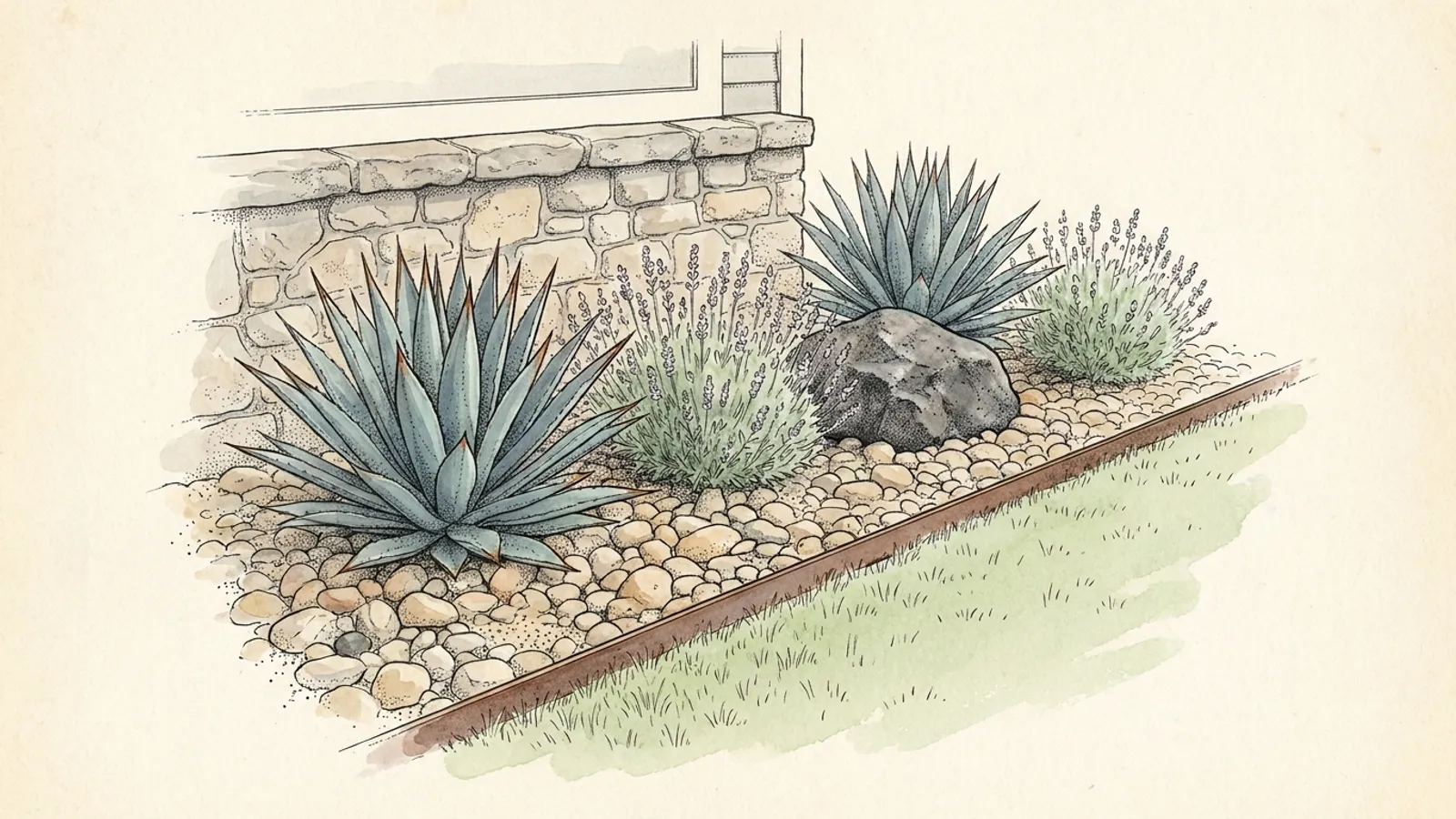
- Install edging before the rock goes in. Steel, aluminum, stone or brick edging all work; it keeps the rock out of the lawn and gives a clean line.
- Spread from piles, not from one big heap. Tip wheelbarrow loads every few feet and rake them out to an even depth.
Weights are typical for dry, loose rock. Ask your supplier whether they sell by the yard or the ton, and use their weight per yard if they publish one.
Questions people ask
- How much landscape rock do I need?
- Square feet × depth in inches ÷ 12 gives cubic feet; divide by 27 for cubic yards. A 200 square foot bed at 2.5 inches deep needs about 1.55 cubic yards, or about 1.7 cubic yards with 10 percent extra, which is roughly 2.3 tons.
- How many tons of landscape rock do I need for 100 square feet?
- At 2 inches deep, 100 square feet needs about 0.62 cubic yards, or 0.83 tons. At 3 inches it needs 0.93 cubic yards (1.25 tons) and at 4 inches 1.23 cubic yards (1.67 tons), before extra.
- What size decorative rock is best for beds?
- 3/4 inch to 1½ inch rock is the most common for planting beds because it is easy to spread and rake around plants. Larger 1 to 3 inch rock suits open areas and drainage, and needs a deeper layer.
- Do I need landscape fabric under rock?
- It is strongly recommended in beds without plants you want to spread. Permeable fabric keeps rock from sinking into the soil and slows weeds. Skip it where you want plants to self-seed or spread.
- Is decorative rock heavier than mulch?
- Much heavier. A cubic yard of most decorative rock weighs about 2,700 pounds, so a yard that fills one pickup bed of mulch would overload many pickups as rock.