The boulder weight formula
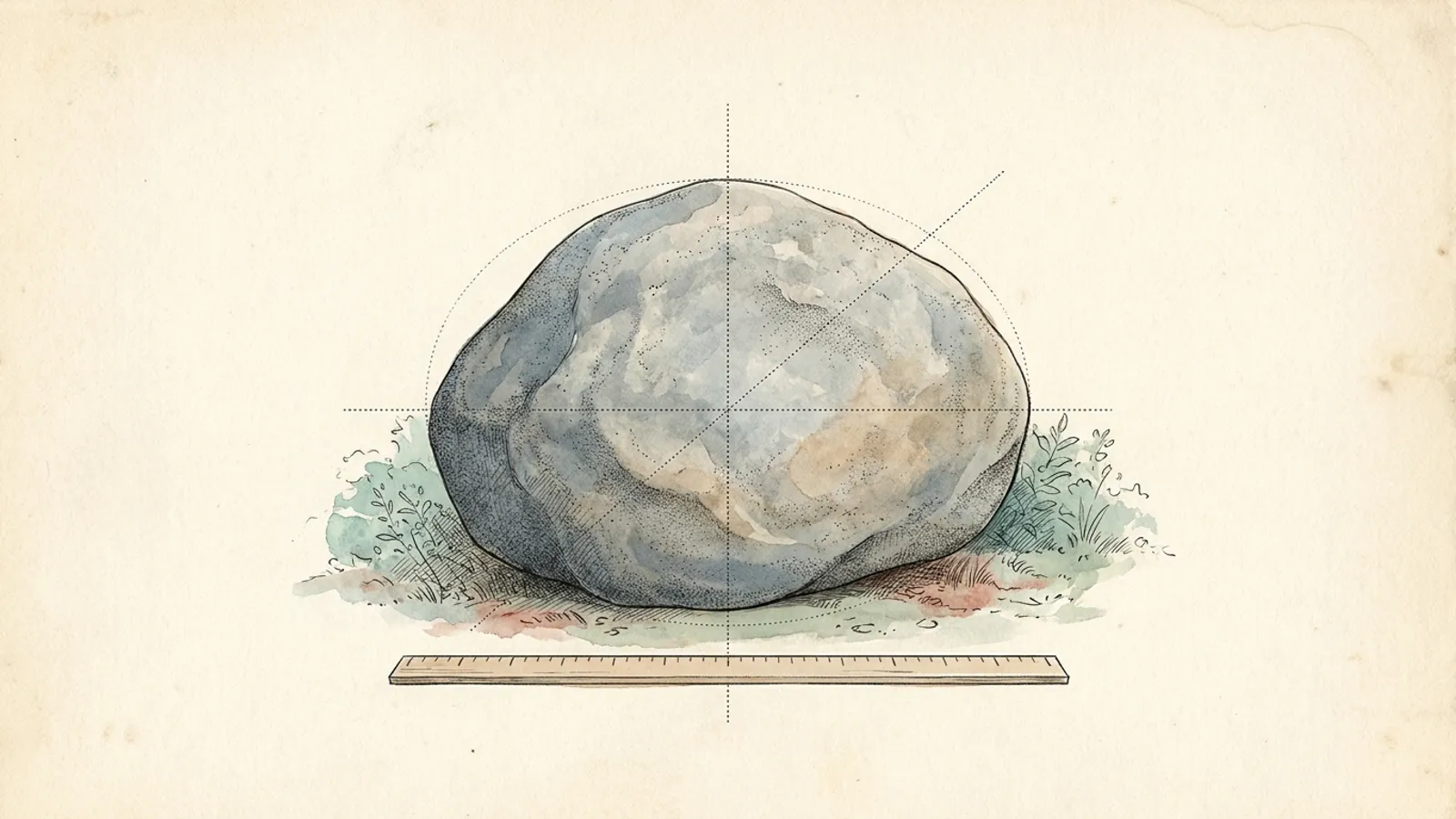
A rounded boulder is close to an ellipsoid: an egg or squashed ball with three different measurements. Its volume is:
volume (cu ft) = π ÷ 6 × length × width × height = 0.5236 × L × W × H
weight (lb) = volume × stone density (lb per cu ft)
The 0.5236 is there because an ellipsoid fills about 52% of the box drawn around it. A perfectly square block would fill 100%, so if your stone is blocky with flat faces and sharp corners, choose Block or slab instead, or take a value between the two.
Worked example
A granite boulder 3 ft long, 2 ft wide and 2 ft tall:
- Volume: 0.5236 × 3 × 2 × 2 = 6.28 cu ft
- Weight: 6.28 × 168 lb = 1,056 lb, or about 0.53 tons
- Likely range for granite (162–175 lb per cu ft): about 1,020–1,100 lb, before allowing for the shape not being perfect
The same boulder in sandstone (about 145 lb per cu ft) would be about 910 lb.
How to measure a boulder
- Length: the longest straight line across the stone.
- Width: the widest point at right angles to the length.
- Height: from the ground to the top. If part of it is buried, estimate the buried depth and add it.
Measure to the bulk of the stone, not to a single knob sticking out. If the boulder is irregular, measure two or three times and average.
Weight of round boulders
For a ball-shaped boulder, all three measurements are the same. These are estimates for solid stone:
| Diameter | Volume | Granite (168 lb/cu ft) | Sandstone (145 lb/cu ft) |
|---|---|---|---|
| 1 ft (12”) | 0.52 cu ft | about 88 lb | about 76 lb |
| 1.5 ft (18”) | 1.77 cu ft | about 300 lb | about 260 lb |
| 2 ft (24”) | 4.19 cu ft | about 700 lb | about 610 lb |
| 2.5 ft (30”) | 8.18 cu ft | about 1,370 lb | about 1,190 lb |
| 3 ft (36”) | 14.1 cu ft | about 2,380 lb (1.2 tons) | about 2,050 lb |
| 4 ft (48”) | 33.5 cu ft | about 5,630 lb (2.8 tons) | about 4,860 lb |
| 5 ft (60”) | 65.4 cu ft | about 11,000 lb (5.5 tons) | about 9,490 lb |
Weight rises with the cube of the size: a boulder twice as wide weighs about eight times as much. That is why a 4 ft boulder is a machine job when a 2 ft one is not.
Weight of typical landscape boulders
Most landscape boulders are longer than they are tall. Granite, ellipsoid estimate:
| Length × width × height | Volume | About lb | About tons |
|---|---|---|---|
| 2 × 1.5 × 1.5 ft | 2.36 cu ft | 400 | 0.2 |
| 3 × 2 × 2 ft | 6.28 cu ft | 1,060 | 0.53 |
| 3 × 2.5 × 1.5 ft | 5.89 cu ft | 990 | 0.49 |
| 4 × 3 × 2.5 ft | 15.7 cu ft | 2,640 | 1.3 |
| 5 × 4 × 3 ft | 31.4 cu ft | 5,280 | 2.6 |
| 6 × 4 × 3 ft | 37.7 cu ft | 6,330 | 3.2 |
Stone densities used
| Stone | About lb per cu ft | Range |
|---|---|---|
| Granite | 168 | 162–175 |
| Basalt | 180 | 172–187 |
| Limestone | 160 | 145–170 |
| Sandstone | 145 | 137–162 |
| Marble | 170 | 162–175 |
| Slate | 172 | 168–175 |
| Quartzite | 165 | 162–168 |
| Fieldstone (mixed) | 165 | 155–175 |
These come from typical specific gravities: water is 62.4 lb per cubic foot, and most of these rocks are 2.3 to 3.0 times as dense. Porous volcanic boulders (lava rock) are much lighter and vary too much to list; ask the supplier.
Why the estimate matters
- Moving it. Compare the estimate with the rated lifting capacity of the skid steer, tractor or truck boom you plan to use, and leave a safety margin. Never rely on a rough estimate to work right at a machine’s limit.
- Delivery. Boulders are often sold by the ton, and the delivery truck has a weight limit. Knowing the rough weight helps you plan loads.
- Buying. If one yard prices by the piece and another by the ton, the estimate lets you compare. See the landscape rock cost guide.
- Walls. Planning a boulder retaining wall? The stone wall calculator estimates the total tons.
This is an estimate, not a weighing. Real boulders have hollows, bumps and cracks, and the stone itself varies. For lifting, rigging or transport decisions, allow a generous margin or have the stone weighed.
Questions people ask
- How much does a boulder weigh?
- A round 2 foot granite boulder weighs roughly 700 pounds, a 3 foot one about 2,400 pounds and a 4 foot one about 5,600 pounds. Most landscape boulders are flatter than a ball, so measure all three dimensions for a closer estimate.
- How do you calculate the weight of a boulder?
- Treat it as an ellipsoid: volume in cubic feet = 0.5236 × length × width × height (all in feet). Multiply by the stone's density, about 168 pounds per cubic foot for granite, to get pounds. Divide by 2,000 for tons.
- How much does a cubic foot of boulder weigh?
- Solid stone weighs about 145 to 180 pounds per cubic foot: sandstone near 145, limestone near 160, granite about 168 and basalt about 180.
- How accurate is a boulder weight estimate?
- For a reasonably rounded boulder, expect the real weight to be within about 20 percent of the estimate. Very angular or blocky stones weigh more than the ellipsoid formula suggests; hollowed or flat stones weigh less.
- What size boulder weighs a ton?
- A rounded granite boulder about 3 feet long, 2¾ feet wide and 2¾ feet tall weighs roughly a ton (2,000 pounds). A ball-shaped one would be about 2 feet 10 inches across.