How the decomposed granite calculator works
The calculator works out the finished, compacted volume, then scales it up to the loose volume you have to order:
finished cu ft = square feet × finished depth (in) ÷ 12
loose cu yd to order = finished cu ft × (1 + compaction %) ÷ 27
tons = cu yd × about 1.3
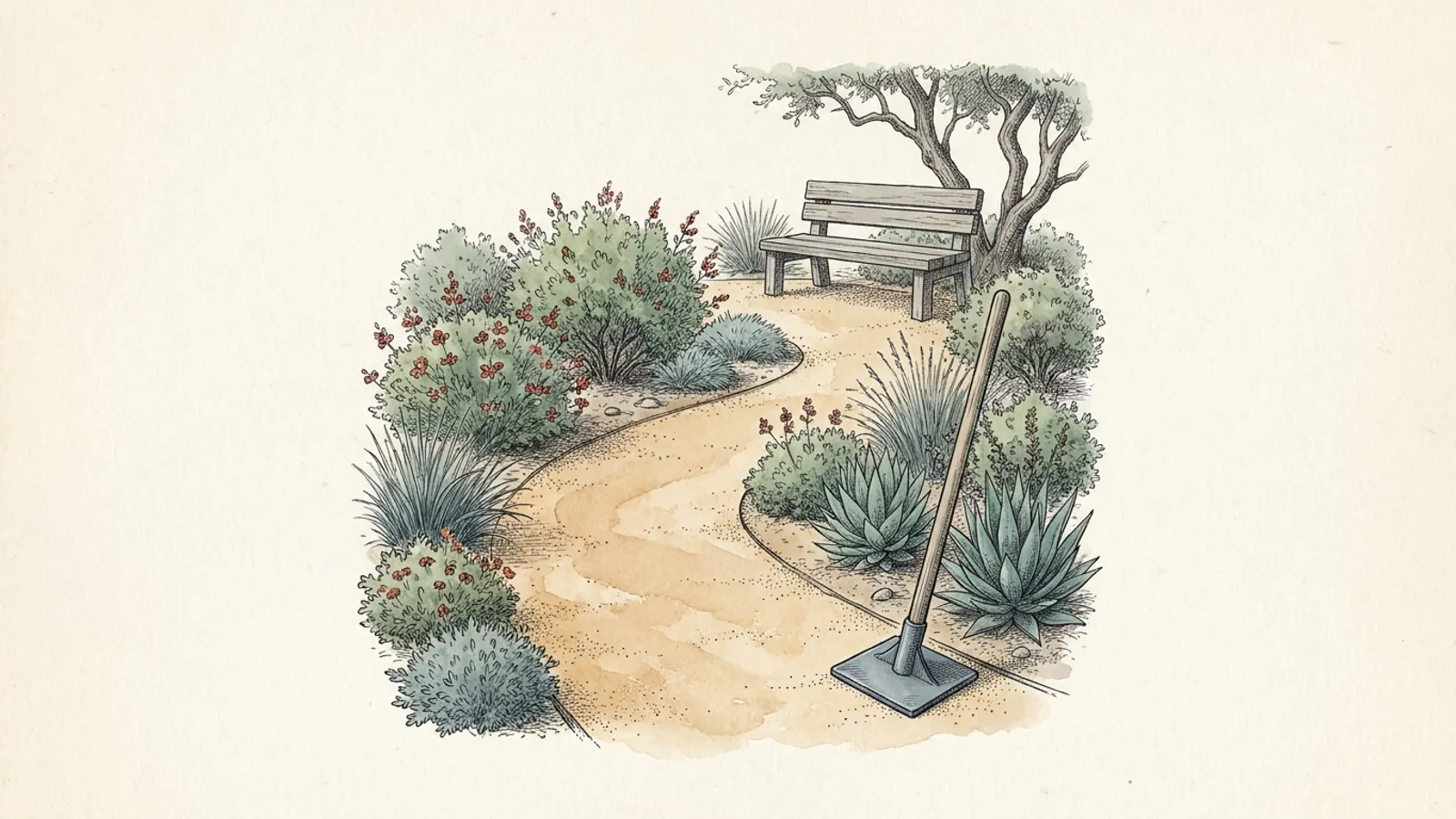
Worked example: a garden path
A path 30 ft long and 4 ft wide, 3 inches deep when finished:
- Area: 30 × 4 = 120 sq ft
- Finished volume: 120 × 0.25 ft = 30 cu ft
- Plus 25% for compaction and waste: 37.5 cu ft
- Cubic yards: 37.5 ÷ 27 = 1.39 cu yd
- Tons: 1.39 × 2,600 ÷ 2,000 = 1.81 tons
Worked example: a small patio
A 12 × 12 ft seating area at 4 inches: 144 sq ft × 0.333 ft = 48 cu ft finished, × 1.25 = 60 cu ft loose = 2.22 cu yd, about 2.9 tons.
How deep should decomposed granite be?
| Use | Finished DG depth | Under it |
|---|---|---|
| Top dressing around plants | 2” (loose, not compacted) | Bare soil or fabric |
| Garden path or walkway | 3” compacted | Firm native soil; a compacted base of crushed rock on soft or clay soil |
| Patio or seating area | 3–4” compacted | A compacted crushed rock base is usual |
| Parking pad or light driveway | 4–6” compacted | A thicker compacted base; ask your supplier for local practice |
Choosing a use in the calculator fills in the finished depth. For top dressing that will not be compacted, you can lower the compaction allowance to 5–10%.
Why DG needs a compaction allowance
Loose DG is a mix of small granite grains and fine dust. When you wet it and run a plate compactor or hand tamper over it, the fines fill the gaps between the grains and the layer gets thinner and firmer. That is the whole point of DG: it becomes a walkable surface. It also means that a 3 inch finished path takes noticeably more than 3 inches of loose DG. Installers usually lay it in lifts of 1–2 inches, wetting and compacting each one.
If you skip the allowance, the path ends up thin, and topping up a compacted DG surface later rarely blends in well.
Weight of decomposed granite
| Material | About lb per cu yd | About tons per cu yd | 1 ton is about |
|---|---|---|---|
| Decomposed granite, loose | 2,400–2,900 (2,600 used) | 1.2–1.45 | 0.77 cu yd |
| Crushed granite, 1/4”–3/4” | 2,500–2,900 (2,700 used) | 1.25–1.45 | 0.74 cu yd |
DG is often delivered damp, which adds weight. If you buy by the ton, ask the yard how many cubic yards a ton of their DG fills.
Decomposed granite or crushed granite?
Decomposed granite packs into a firm, slightly soft surface that looks natural in dry gardens. It can track onto shoes when new and can wash out on steep slopes or under downspouts. “Stabilized” DG has a binder mixed in so it sets harder and resists erosion, and resin-bound versions are firmer still; both cost more and are installed to the maker’s instructions.
Crushed granite is angular chips, usually 1/4 inch to 3/4 inch, that stay loose like gravel. It drains well and does not track as much, but it is less comfortable for chairs and wheels. To calculate crushed granite, choose it in the rock type list. It is not compacted, so set the extra to 10%.
Estimating the cost
Put your supplier’s price per ton or per cubic yard in the price box and the calculator multiplies it out. Remember to add delivery, a base layer if you need one, edging, and compactor rental if you are doing it yourself. The landscape rock cost guide explains how to compare quotes in tons and yards.
Compaction varies with the DG's grading and moisture and with how hard you compact it. The 25% default is a starting point; if your supplier or installer recommends a different allowance for their product, use theirs.
Questions people ask
- How much decomposed granite do I need?
- Multiply the area in square feet by the finished depth in inches ÷ 12 to get cubic feet, add about 20 to 25 percent for compaction, then divide by 27 for cubic yards. A 30 × 4 ft path at 3 inches needs about 1.4 cubic yards of loose DG.
- How much does a cubic yard of decomposed granite weigh?
- Loose DG weighs about 2,400 to 2,900 pounds per cubic yard, roughly 1.2 to 1.45 tons. The calculator uses 2,600 pounds. Damp DG, which is how it is usually delivered, is at the heavier end.
- How deep should decomposed granite be?
- About 2 inches as a top dressing around plants, 3 inches compacted for a garden path, 3 to 4 inches for a patio and 4 to 6 inches for a parking pad, laid over a compacted base where the soil is soft.
- What is the difference between decomposed granite and crushed granite?
- Decomposed granite is granite that has weathered into small particles and fines, so it packs into a firm surface. Crushed granite is quarried granite broken into angular chips, usually 1/4 inch and up, which stay loose like gravel.
- How much compaction should I allow for DG?
- Allowances of about 15 to 25 percent are common for DG that will be wetted and compacted. The calculator uses 25 percent by default to cover a little spreading waste as well.