How to calculate river rock
River rock is measured like any loose rock: area × depth gives volume, and volume ÷ 27 gives cubic yards. What makes river rock different is the size range. A bag of 3/4 inch pebbles and a pile of 3–5 inch cobbles need very different depths, which is why the calculator asks for the size first.
cubic yards = length × width × (depth in inches ÷ 12) ÷ 27
tons = cubic yards × 1.35 (about 2,700 lb per cubic yard)
Worked example: 1–3 inch river rock
A 20 × 10 ft bed in 1–3 inch river rock, 4 inches deep:
- 20 × 10 = 200 sq ft
- 200 × (4 ÷ 12) = 66.7 cu ft
- 66.7 ÷ 27 = 2.47 cu yd, or 2.72 cu yd with 10% extra
- 2.72 × 1.35 = 3.67 tons
- 73.3 cu ft ÷ 0.5 = 147 bags if you go the bagged route
River rock sizes and how deep to lay them
The rule the calculator uses: depth ≈ 2 × the average stone size, at least 2 inches. Big cobbles are the exception; lay them one stone deep.
| Size sold as | Average stone | Depth | 1 cu yd covers | 1 ton covers |
|---|---|---|---|---|
| 3/8”–3/4” river pebbles | about 0.6” | 2” (minimum) | 162 sq ft | about 120 sq ft |
| 3/4”–1½” | about 1.1” | 2.5” | 130 sq ft | about 96 sq ft |
| 1”–3” (“1–3 river rock”) | 2” | 4” | 81 sq ft | about 60 sq ft |
| 2 inch river rock (about 1½”–2½”) | 2” | 4” | 81 sq ft | about 60 sq ft |
| 2”–4” | 3” | 6” | 54 sq ft | about 40 sq ft |
| 3”–5” cobble | 4” | about 5”, one layer | 65 sq ft | about 48 sq ft |
| 4”–8” cobble | 6” | about 8”, one layer | 41 sq ft | about 30 sq ft |
Size names are not standard between yards. “Medium river rock” at one yard may be 1–2 inches and at another 2–4 inches, so ask for the actual range in inches.
How much does river rock weigh?
A loose cubic yard of river rock weighs about 2,500–2,900 lb, and the calculator uses 2,700 lb (1.35 tons). A pile of similar-sized round stones is roughly 60% stone and 40% air. Mixed sizes pack tighter, because small stones fill the gaps between big ones, so a “1–3 inch” mix tends to weigh a little more per yard than a single size. Rock that has just been washed or rained on can weigh several percent more.
Smooth, glossy Mexican beach pebbles are a little denser at about 2,800 lb per yard. Both are in the rock type list above.
How far does a ton of river rock go?
| Depth | 1 ton covers | 1 cu yd covers | 0.5 cu ft bag covers |
|---|---|---|---|
| 2 inches | about 120 sq ft | 162 sq ft | 3 sq ft |
| 3 inches | about 80 sq ft | 108 sq ft | 2 sq ft |
| 4 inches | about 60 sq ft | 81 sq ft | 1.5 sq ft |
| 6 inches | about 40 sq ft | 54 sq ft | 1 sq ft |
For any other amount, the rock coverage calculator works out the square footage.
Dry creek beds
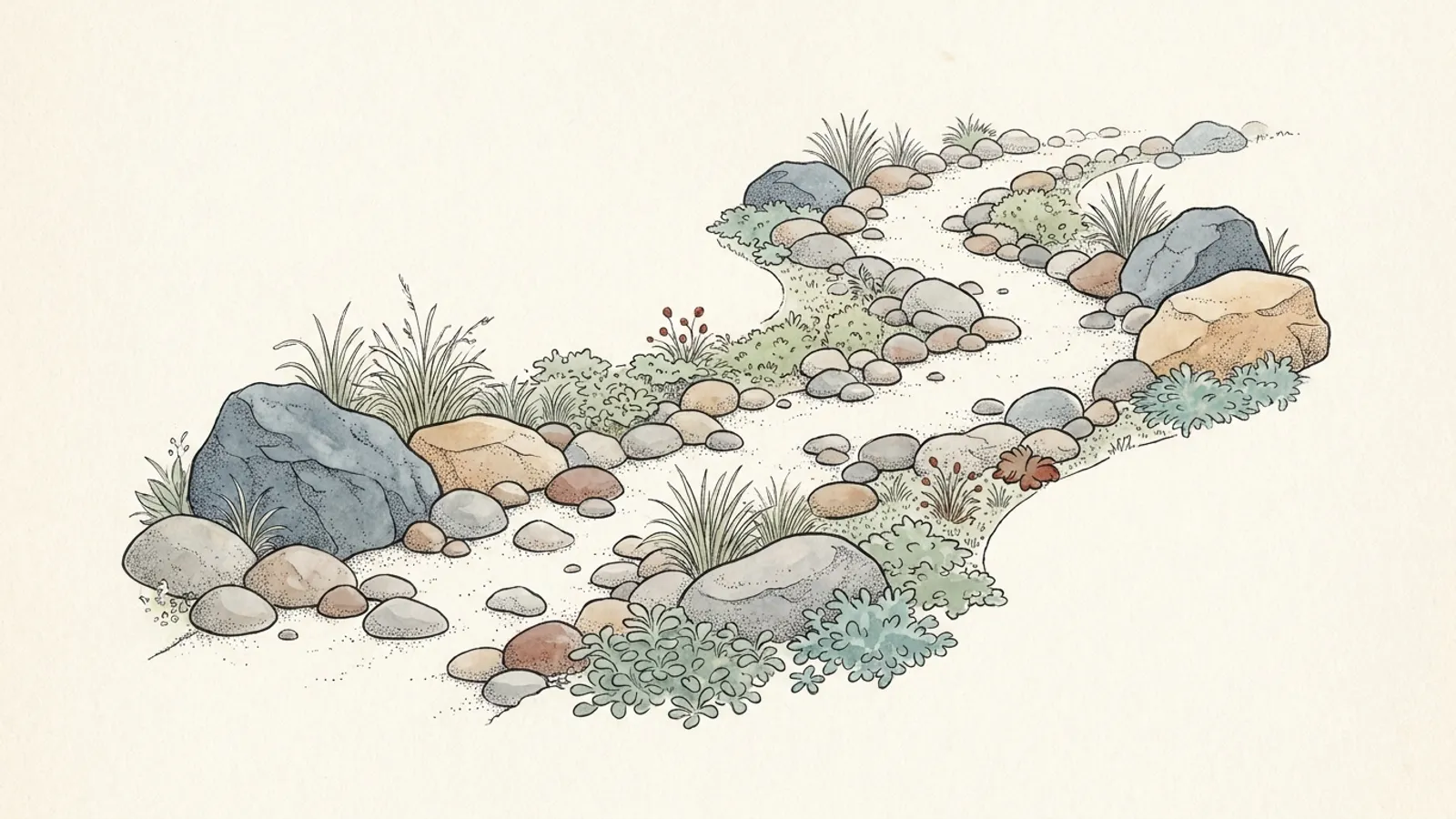
A dry creek bed is a shallow channel lined with river rock, often with a few boulders along the edges. Calculate it as a long rectangle using the average depth of rock across the channel, since it is usually deeper in the middle than at the edges.
Example: a channel 30 ft long and 3 ft wide, with rock averaging 6 inches deep:
- 30 × 3 = 90 sq ft
- 90 × 0.5 ft = 45 cu ft = 1.67 cu yd
- Plus 10%: 1.83 cu yd, about 2.5 tons
Many builders mix sizes: larger 2–4 inch or 3–5 inch stones along the bottom and sides, with 1–3 inch rock filling between them. Run the calculator once for each size and the share of the area it covers. If you are adding edge boulders, the boulder weight calculator estimates what each one weighs, which matters when you plan how to move them.
Tips before you buy
- Lay landscape fabric first in beds and creek beds. River rock pressed straight into soil slowly disappears.
- Wash it or ask for washed rock if you want clean color from day one. Unwashed rock can carry dust and fines.
- Mind the edges. Round stones roll. A steel or stone edge stops them migrating into the lawn.
- Prices are by the yard or the ton. To compare, multiply a price per ton by 1.35 to get an approximate price per cubic yard. The landscape rock cost guide explains the rest of the bill.
Weights are averages for dry, loose rock. If your supplier gives a weight per yard for their river rock, multiply the cubic yards by their number instead of ours.
Questions people ask
- How much river rock do I need?
- Multiply length × width in feet, then by the depth in inches ÷ 12, and divide by 27 for cubic yards. For 1 to 3 inch river rock at 4 inches deep, a 200 square foot bed needs about 2.5 cubic yards, or 3.3 tons, before you add 10 percent extra.
- How deep should 1-3 inch river rock be?
- About 4 inches. The average stone is about 2 inches, and twice the average size gives enough overlap to hide the soil or fabric. You can go to 3 inches to save money, but expect to see more gaps.
- How much does a cubic yard of river rock weigh?
- About 2,500 to 2,900 pounds, or 1.25 to 1.45 tons. The calculator uses 2,700 pounds (1.35 tons). Wet rock and mixed sizes weigh more.
- How many square feet does a ton of river rock cover?
- About 120 square feet at 2 inches deep, 80 at 3 inches, 60 at 4 inches and 40 at 6 inches.
- How many bags of river rock are in a yard?
- 54 bags of 0.5 cubic feet. Each bag weighs about 50 pounds and covers about 2 square feet at 3 inches deep.